
Your 2025 End-of-Year HR Checklist: 7 Steps to a Smooth Wrap-Up
As the end of the year approaches, the pressure on HR departments across Australia shifts from daily operations to a complex administrative and compliance sprint. Here are the 7 essential steps to ensure your organisation closes the year cleanly.
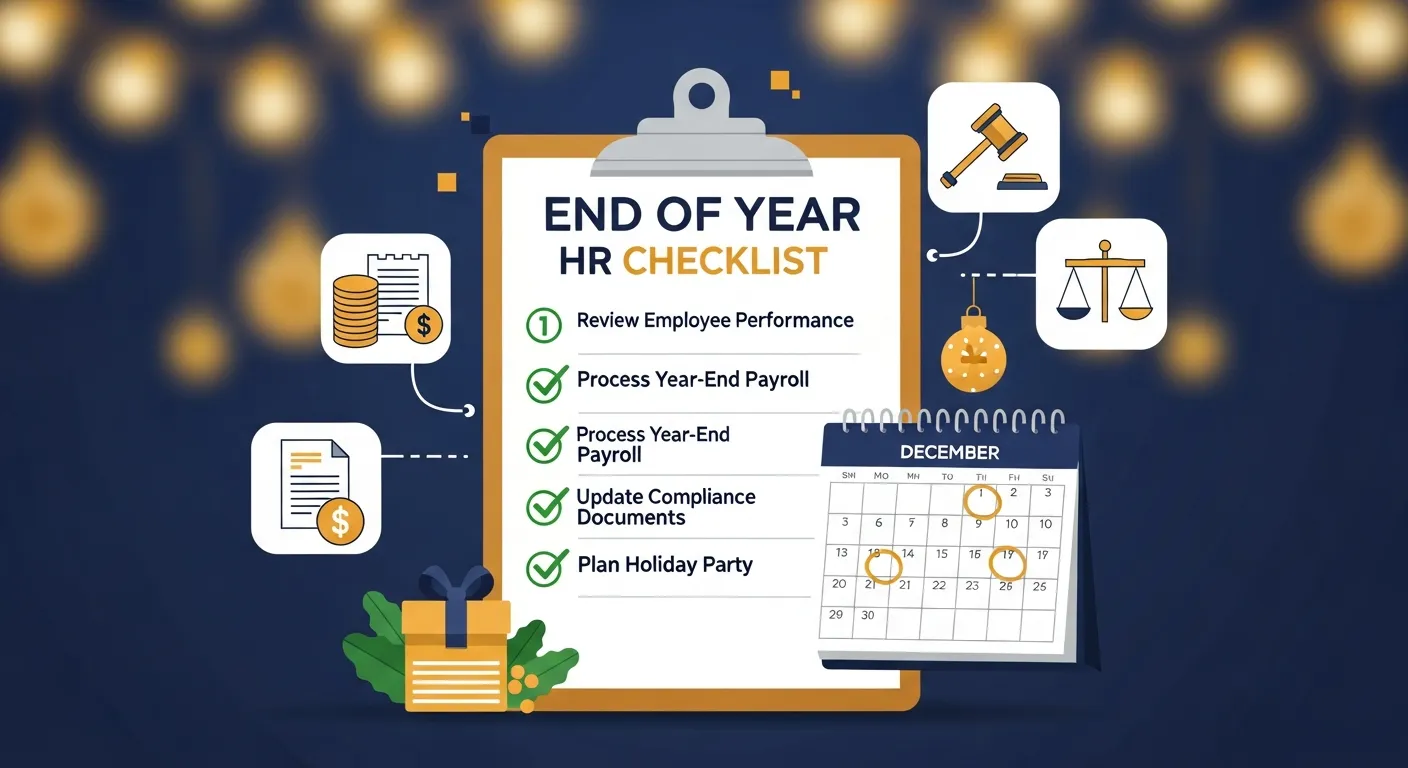
As the end of the year approaches, the pressure on HR departments across Australia shifts from daily operations to a complex administrative and compliance sprint. For HR leaders, this period—which encompasses everything from performance reviews and compliance audits to payroll finalisation—often feels less like a wrap-up and more like a tightrope walk.
The difference between a frantic December and a smooth transition into January often comes down to one thing: a comprehensive checklist and the system to back it up.
Here are the 7 essential steps to ensure your organisation closes the year cleanly, reduces administrative stress, and sets the stage for a strategic 2026.
1. Audit Your Leave Balances and Accruals
The Task: Ensure all employee annual leave, sick leave, and long service leave balances are accurate and up-to-date before the final payroll run. This is a critical compliance checkpoint, especially concerning annual leave liabilities on your balance sheet.
The Pain Point: If you rely on basic HR systems or separate spreadsheets for leave, reconciliation becomes a manual nightmare. The average payroll error costs Australian businesses approximately $35 billion annually (Australian Payroll Association).
The Growth Insight: A future-proof HRIS—one built as a service, not an off-the-shelf product—offers customisable accrual rules that automatically calculate complex award conditions, eliminating manual auditing entirely.
2. Finalise and Lock Down Payroll Data
The Task: Identify and resolve all outstanding payroll anomalies, errors, or manual adjustments for the year. This includes correctly coding any fringe benefits tax (FBT) items, final expense claims, and end-of-year bonuses.
The Pain Point: Discrepancies between basic HR and payroll platforms (a common result of shallow integration) require days of manual data matching. Relying on manual processes means that each payroll error costs an average of $291 to correct (Lano.io).
The Growth Insight: Strategic businesses demand deep, two-way integration. The end of the year is when you most acutely feel the cost of systems that don't speak fluently to your primary payroll and finance software.
3. Prepare for Compliance Reporting (FWO & WHS)
The Task: Ensure all mandatory records are consolidated for end-of-year reporting obligations, including Fair Work Ombudsman (FWO) records and Workplace Health & Safety (WHS) incident data.
The Pain Point: Relying on siloed systems or paper records means crucial data for compliance is scattered, turning an audit into a scramble. Failure to comply can be financially severe: Fair Work non-compliance penalties can reach $93,900 per breach for businesses and $18,780 for individuals.
4. Conduct a Data Integrity Cleanse
The Task: Review your core employee records for consistency. Check employee contact details, bank details, emergency contacts, and position titles.
The Pain Point: Basic systems often lack strong data validation tools. Each manual HR data entry task has an average estimated cost of $4.78 (Ernst & Young), a figure that climbs steadily each year.
5. Review and Close Out Performance Cycles
The Task: Complete all remaining 2025 performance reviews, ensure all feedback is logged, and finalise ratings/goals.
The Pain Point: Rigid, basic systems force standardised, tick-box performance review templates that don't capture complex management feedback.
6. Budget and Plan for 2026 Headcount
The Task: HR works closely with finance and department heads to forecast hiring needs, turnover projections, and training budgets for the new year.
The Pain Point: Without consolidated data, budget planning becomes a series of educated guesses. Manual data extraction can lead to staff workloads increasing by 40-60% during month-end periods.
7. Plan for System Documentation and Team Training
The Task: Schedule a quick system review in early January. Document any new processes established late in the year and ensure all HR staff are trained on year-end learnings.
By addressing these seven steps now, you can mitigate compliance risks, avoid a chaotic start to the new financial year, and transition your focus to strategic growth.